
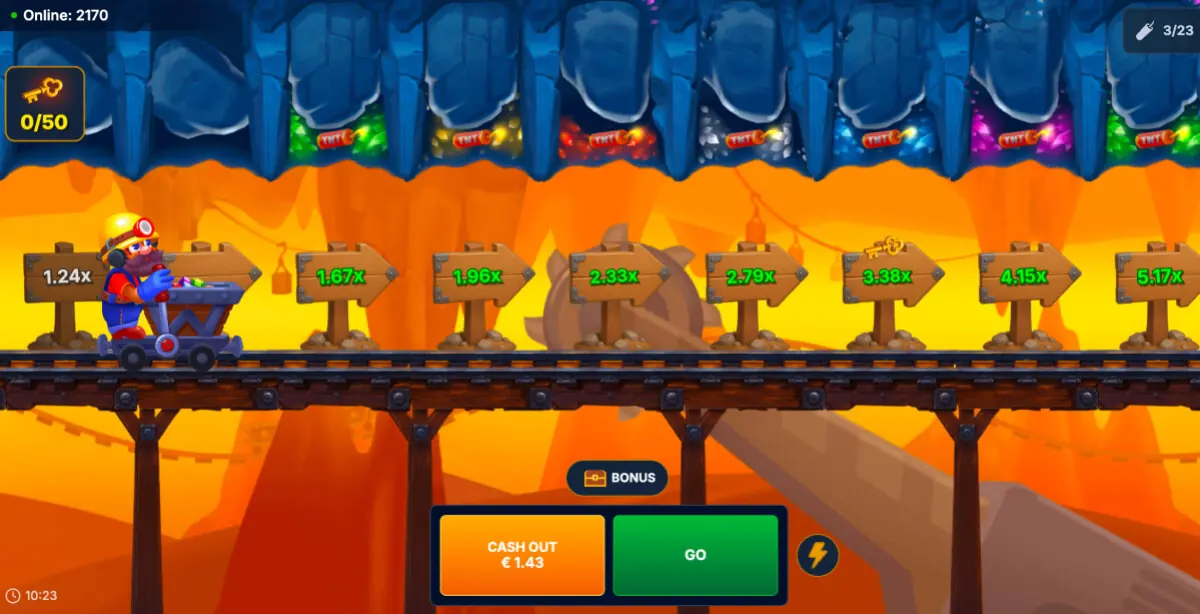
Demo can show
- Control locations and screen flow
- How risk labels appear
- Cash-out and TNT interface states
- How key counters are displayed
- Treasure Hook visual sequence
Mine Rush field guide
Demo mode is useful for learning Mine Rush controls with virtual credit. It is not a predictor and not evidence that real-money withdrawals work. Use a structured practice checklist and keep game mechanics separate from operator quality.

Practice routine
The loading screen and lobby should identify VeliPlay and Mine Rush.
Record the displayed RTP, language, currency and any version identifier.
Observe how purchase prices and the key track respond.
Compare route pacing without claiming a probability from a few rounds.
Wait for confirmation and identify the next decision state.
Compare the displayed multiplier with the recorded virtual return.
Confirm that the open round ends and check whether credited keys remain.
Verify how progress is stored for that stake and difficulty pair.
Find the round ID, multiplier fields and key result where available.
Extra virtual rounds do not prove a profitable system.
Evidence limits
The emotional environment also changes with money. A calm demo decision can become a chase after a cash loss. If real play is lawful and chosen, keep the same preset budget and stop rules rather than assuming virtual discipline will automatically carry over.
Access status
An iframe requires a provider-approved demo URL and permission to embed it. The evidence set does not supply a stable public Mine Rush endpoint. Loading an operator game without its authentication or terms can also break, leak referrer data or imply a partnership that does not exist.
Use the play route only after checking age, local law and operator licensing. If an official VeliPlay demo endpoint becomes public, the site can add a click-to-load frame with a consent boundary, sandbox permissions, a static poster and a fallback link. Until then, a fake demo would be worse than an honest explanation.
After practice
A useful demo note lists the control location, selected mode, settlement state, key-counter behaviour and any accessibility problem. It should also list unanswered fields: exact step odds, real stake limits, withdrawal handling and whether virtual progress transfers. This prevents interface familiarity from being mistaken for operator trust.
If practice causes an urge to deposit immediately or chase a virtual loss, stop. Demo mode removes the cash stake but can still reinforce rapid repetition. A cooling-off period is reasonable even before real-money play.
Refresh after a virtual round and verify how history and key progress return. This reveals interface behaviour without suggesting that the demo predicts funded outcomes.
Direct answers
Virtual-credit demo play does not risk a cash stake, but use it only on a verified site and avoid submitting payment data to an untrusted demo host.
The public VeliPlay page publishes 96% for Mine Rush but does not separately document demo configuration. Check the in-game rules of the specific build.
Do not assume that virtual progress transfers. Demo and account balances may use separate sessions or storage; verify the operator rules.
No. Practice reveals interface states and pacing, not a repeatable TNT sequence or future live outcome.
That depends on the authorised operator or provider demo route. Do not create an account merely because a third-party page labels itself a free demo.
Test stake changes, all three risk modes, GO, CASH OUT, result history and how key counters change across stake-and-difficulty pairs.