
Composition
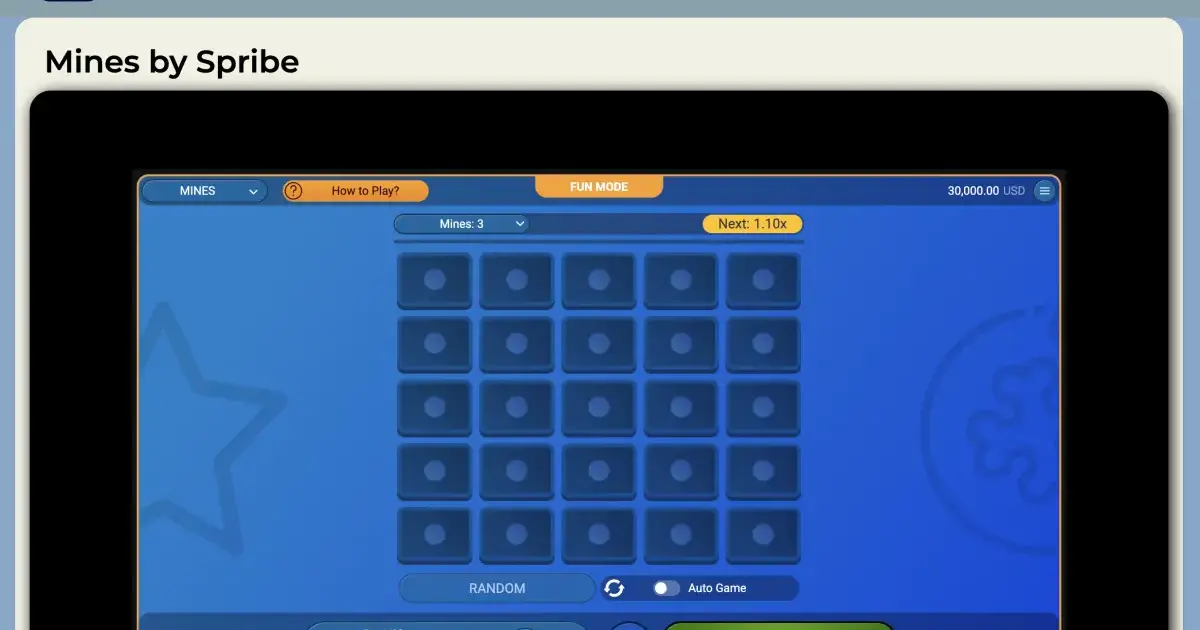
The competitor screenshot devotes most of the viewport to a bright blue 5×5 game board. The surrounding site is sparse and the actual game supplies nearly all visual character.
Field comparison · not a paid ranking
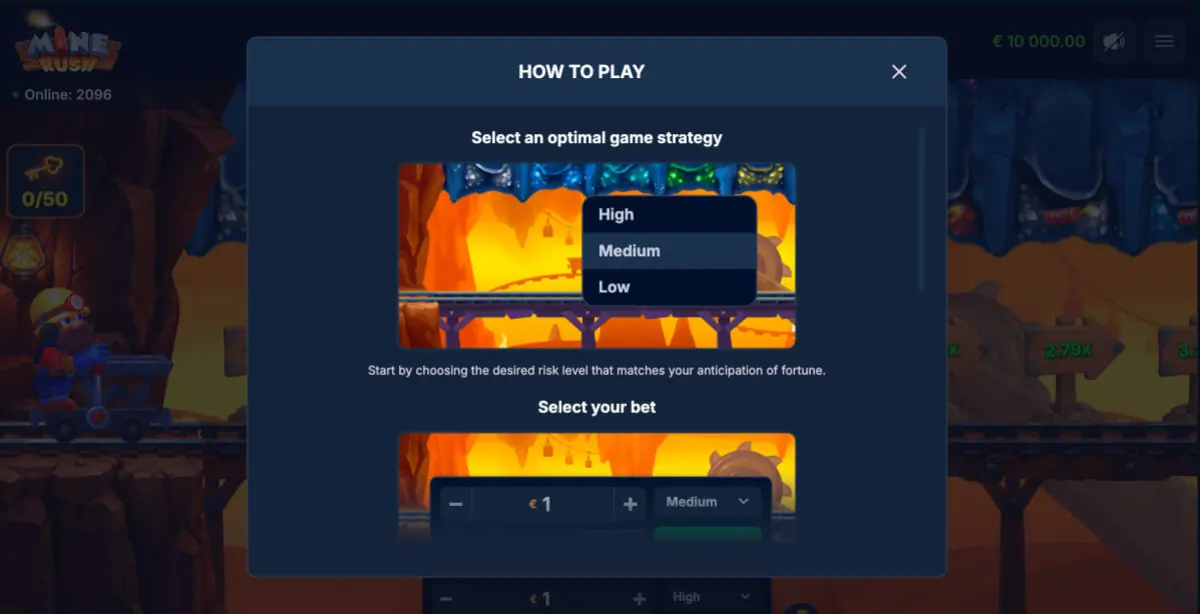
Both use stop-or-continue decisions; Mines gives tile selection, while Mine Rush gives a linear route and persistent keys.
Fact matrix
| Field | Mine Rush | Mines | Interpretation |
|---|---|---|---|
| Provider | VeliPlay | SPRIBE | Separate studios and game systems |
| Published RTP | 96% | 97% | Long-run theory, not a session forecast |
| Format | Single-player step crash | Single-player grid-pick mini game | Changes pacing and interaction |
| Core action | GO or CASH OUT | Open a tile or cash out after a safe star | Neither action predicts the next outcome |
| Maximum | 21,661.6× provider-published | Depends on grid setup and operator rules | Ceilings do not state hit frequency |
| Distinct feature | Persistent keys and Treasure Hook | Mine-count choice, autoplay and social modules | Different reasons to return |
| Mine Rush transparency | Exact step odds not public | See source-specific notes | Evidence gaps affect confidence |
| Release context | August 2026 product page | Current SPRIBE catalogue title | Interfaces can change after capture |
RTP is the only field that can be reduced to one theoretical percentage, and even that needs configuration context. A maximum multiplier without its probability does not measure everyday value. A bonus name does not disclose its expected return. The matrix therefore treats format, action and evidence quality as first-class criteria.
Visual audit
The competitor screenshot devotes most of the viewport to a bright blue 5×5 game board. The surrounding site is sparse and the actual game supplies nearly all visual character.
Mine Rush embeds screenshots within a cave-themed editorial system, so page and product look related. This creates stronger continuity but uses more decorative CSS.
Mines exposes all candidate tiles at once. Mine Rush shows a route and next checkpoint, producing less spatial choice and more narrative movement.
Visual comparison is not a beauty contest. We look at whether a reader can identify the product, locate primary actions, distinguish facts from CTAs and understand what evidence exists. Strong art can support those tasks; it cannot replace missing rules.
On mobile, Mine Rush collapses comparison cards to one column and keeps screenshots horizontally intact through object-fit rather than shrinking text into illegibility. Wide tables remain in a labelled scroll container. Rail decoration becomes narrower and less opaque, so it does not steal touch area or cover the content.
Mechanic audit
SPRIBE describes stars and mines hidden on a field. Each safe star raises winnings and allows cash out. Mine Rush uses the same broad risk decision after a safe event but no tile selection.
Mines publishes 97% RTP and multi-device support. Mine Rush publishes 96%.
Mines offers autoplay settings and social modules. Mine Rush differentiates with persistent keys and a three-life chest bonus instead of a configurable mine grid.
Control over stopping is not control over outcome generation. A lower cash-out target can change the frequency and size pattern of settlements, while the title's long-run edge remains. The same rule applies when selecting tiles, spinning reels or making a live prediction: bankroll controls change exposure, not mathematical advantage.
Audience fit
Choose Mines for direct tile choice, a familiar probability-grid presentation and a 97% published RTP. Choose Mine Rush for a guided path, story-led feedback and progression that survives a losing TNT result.
A demo is the right place to compare control density, animation pace and mobile readability. It is not proof of future returns or operator withdrawal quality. Set a short virtual-credit task for each title and stop when the interface question is answered.
Evidence bar
The bars show evidence coverage, not game quality and not win probability. A missing field lowers documentation confidence rather than proving unfairness.
Practical test
Open each available demo on the same phone, at the same browser zoom and under the same network conditions. Spend five minutes identifying the stake control, rules, sound control, current result, history and exit. Do not count virtual profit. Record how many taps each task takes and whether any label becomes hidden when the keyboard, cookie notice or browser toolbar is visible. This turns a vague preference into an accessibility and usability check.
Next, enable the operating system's reduced-motion setting and repeat the navigation task. Mine Rush uses motion to communicate cart travel, so the numerical state and action labels must remain understandable without relying on speed or sparks. For Mines, verify the equivalent primary state: open a tile or cash out after a safe star. Sound should support feedback without becoming the only warning that a state changed.
Rotate the device, increase text size and reopen the page after switching apps. The useful question is whether the current stake, result and next legal action are still obvious. A responsive marketing page does not prove that an embedded operator build has identical behaviour, so test the actual implementation before a funded round. Persistent keys give Mine Rush a visible reason to resume, but they also make it important to confirm which account, stake and risk track was restored.
For a paper comparison, write the number of deliberate decisions per minute, the chosen stake and total turnover. Mines's single-player grid-pick mini game rhythm should not be forced into Mine Rush's checkpoint model. A faster visual loop can increase turnover even when individual stakes look small. A slower loop can still concentrate exposure through a feature purchase. Stop at the written time instead of extending the test to reach a key, target or bonus state.
Give one point when the current rules disclose provider, RTP, maximum or payout boundary, core action, feature cost and dispute history. Give one more when the value is confirmed by a primary provider page. Leave a cell blank when the source is silent; do not award a point because another review repeats the number. This method explains why an attractive screenshot can score strongly for product identity while remaining weak on mathematics.
Finally, keep operator quality outside the game score. Licensing, KYC, deposits, withdrawals and complaint handling belong to the casino account layer. A clearer game does not repair weak operator terms, and a licensed operator does not automatically make every game mechanic well documented. The comparison verdict covers product format and public evidence only.
Failure-mode comparison
Mine Rush can be misread when cart motion receives more attention than the offered multiplier, remaining key track or confirmed settlement. Mines can be misread when open a tile or cash out after a safe star is visually separated from the value it affects. In either game, animation is secondary evidence. The numerical result and server-side history should remain understandable after motion stops.
The provider defines the core game, but a casino controls account currency, supported stakes, regional availability, bonus eligibility, payment flow and complaint route. A screenshot from one operator does not create a universal bet range. The comparison therefore avoids importing an operator-specific minimum into either fact table and does not treat lobby availability as a provider promise.
Mine Rush's saved keys can make an unfinished track feel valuable even after a session limit is reached. Mine-count choice, autoplay and social modules may create a different prompt to continue in Mines. Neither feature changes the affordability of the next wager. A saved objective, visible pot, live round or recent safe choice is not money already owned by the player.
A short demo can reveal layout, pace and control errors; it cannot rank expected value from observed wins. Compare published RTP under matching configurations, then record the fields that remain unknown. If one title supplies a primary rule page and the other only a review-site number, the correct conclusion is an evidence difference, not a fabricated mathematical tie.
This failure-mode pass matters because a polished interface can still encourage a costly misunderstanding. The stronger product for a particular reader is the one whose state they can reliably read, whose pace fits a preset limit and whose current rules can be verified without depending on promotional copy.
Final verdict
Both use stop-or-continue decisions; Mines gives tile selection, while Mine Rush gives a linear route and persistent keys. Choose Mines for direct tile choice, a familiar probability-grid presentation and a 97% published RTP. Choose Mine Rush for a guided path, story-led feedback and progression that survives a losing TNT result.
Mine Rush scores well for interface feedback, cohesive art and a progression system that does not disappear with every TNT. It loses ground on 96% RTP against higher-published titles and on documentation because universal stake limits, exact step odds and a title verifier are absent from its public page.
Mines should be judged on the same standard: current provider rules, measured interaction, visual clarity, mobile behaviour and honest evidence gaps. Do not choose either from a hero multiplier or bonus name alone. Confirm age, jurisdiction, operator licensing and spending limits before any real-money use.
Direct answers
Mines lists 97%, while VeliPlay publishes 96% for Mine Rush. Evidence labels matter: read the source and the exact in-game rules before treating a figure as comparable.
Mine Rush controls are stake, risk mode, GO and CASH OUT. Mines uses this core action: open a tile or cash out after a safe star. Neither control set lets a player predict random or live outcomes with certainty.
That depends on preference. Mine Rush uses a continuous cave-and-rail identity. Mines uses blue 5×5 grid inside a sparse light-blue page. Our page scores clarity and consistency rather than declaring colour taste an objective fact.
No verified system removes either title's house edge. A plan can limit turnover, stake and session length, but it cannot guarantee profit or forecast the next result.
The competitor screenshot was supplied and processed on August 9, 2026. Product and site interfaces can change, so source links and the update date remain visible.