Mine Rush field guide

How to Play Mine Rush: Rules, Controls & Steps

facts, screenshots and links rechecked

Mine Rush uses a short decision loop, but the screen carries several states at once: stake, risk mode, current multiplier, cash-out value and a key counter tied to the selected setup. This guide separates each field so a first round does not become a guessing exercise.

Mine Rush how-to-play screen with game controls and route
CONTROL MAP / 01GO → CHECKPOINT → CASH OUT

Page summary

Short version: choose a stake and risk mode, press GO, then cash out after a safe checkpoint or risk another step. TNT removes the open wager. Credited keys stay saved on the same stake-and-difficulty track and 50 keys open the regular Treasure Hook Bonus.

Screen map

Read the interface before pressing GO

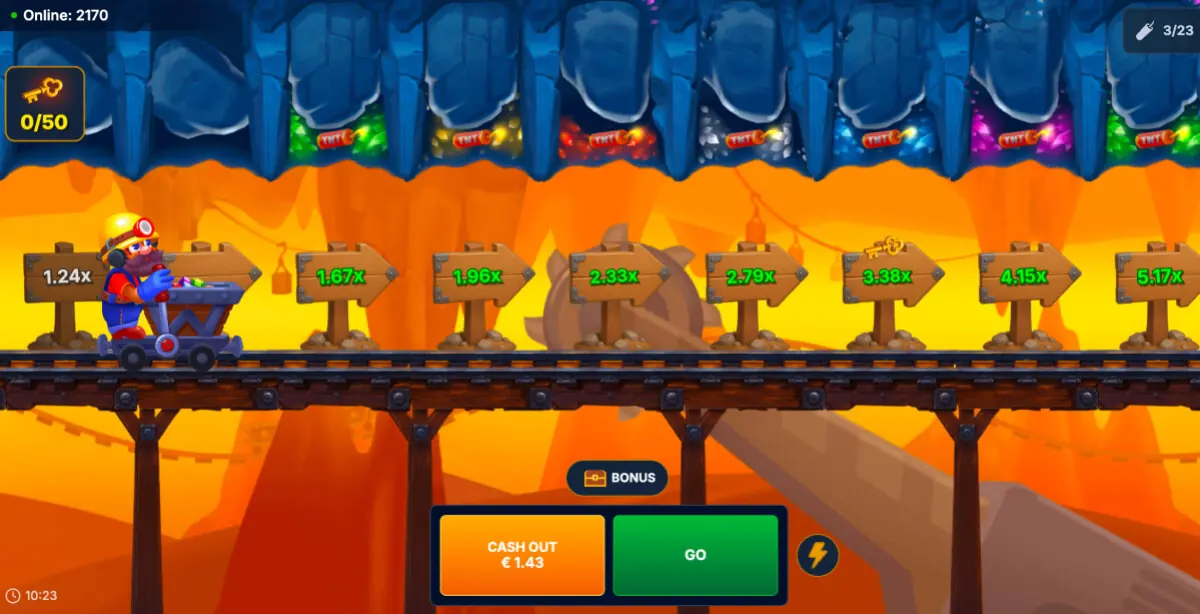
The important controls sit in the lower interface while the route occupies the centre. Read the numbers from commitment to result: stake first, risk second, available cash-out third and key progress last.

Mine Rush instruction screen with stake and risk controls
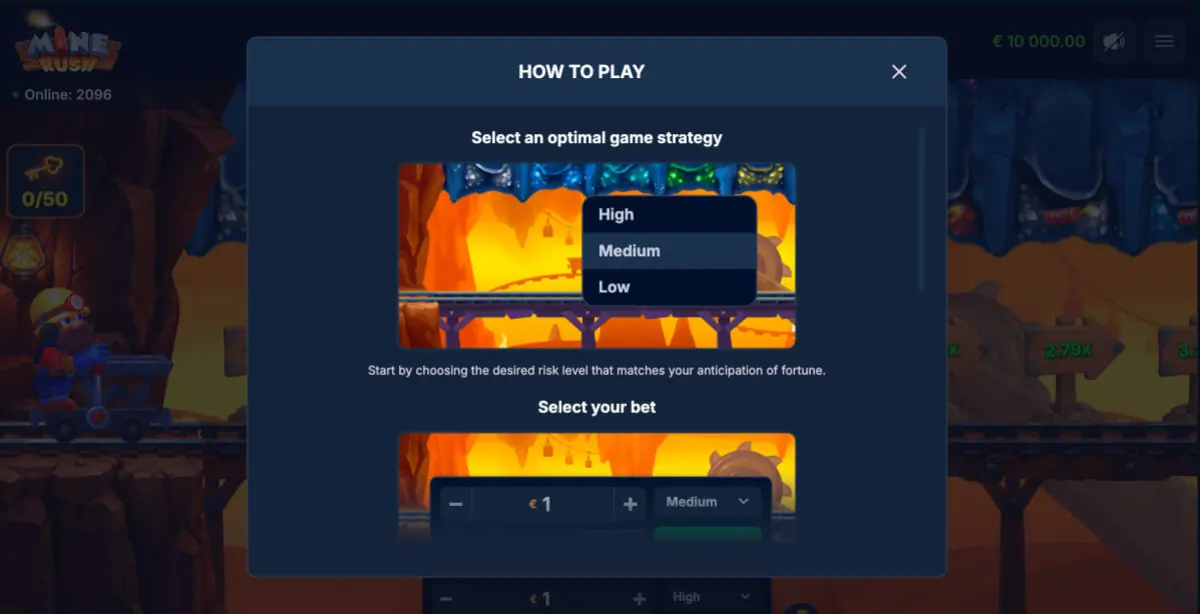
The provider screen introduces stake selection, risk selection and the GO action before any route decision.

Stake field

The selected stake is the amount exposed when GO starts a round. Values visible in screenshots are examples from one build and currency. They are not evidence of a universal minimum or maximum. Read the operator rules before relying on a displayed limit.

Risk selector

Low, Medium and High alter the route profile. The labels communicate relative risk, yet the public page does not give a probability for the next checkpoint. Higher risk should never be read as a promise of better long-run value.

GO and CASH OUT

GO is the risk action. CASH OUT is the settlement action. The second button matters only after a safe step creates an open return. A settled return ends that round; pressing GO keeps it exposed to the next outcome.

Multiplier signs

Wooden signs show the route's possible progression. A visible later value is not money already won. Only the current cash-out amount can be settled, and only before a TNT result closes the round.

Key counter

The counter is a progression field, not part of the open payout. Up to one key can be credited per step. The total is stored for the exact pair of stake and difficulty, which explains why the number can change when settings change.

Statistics panel

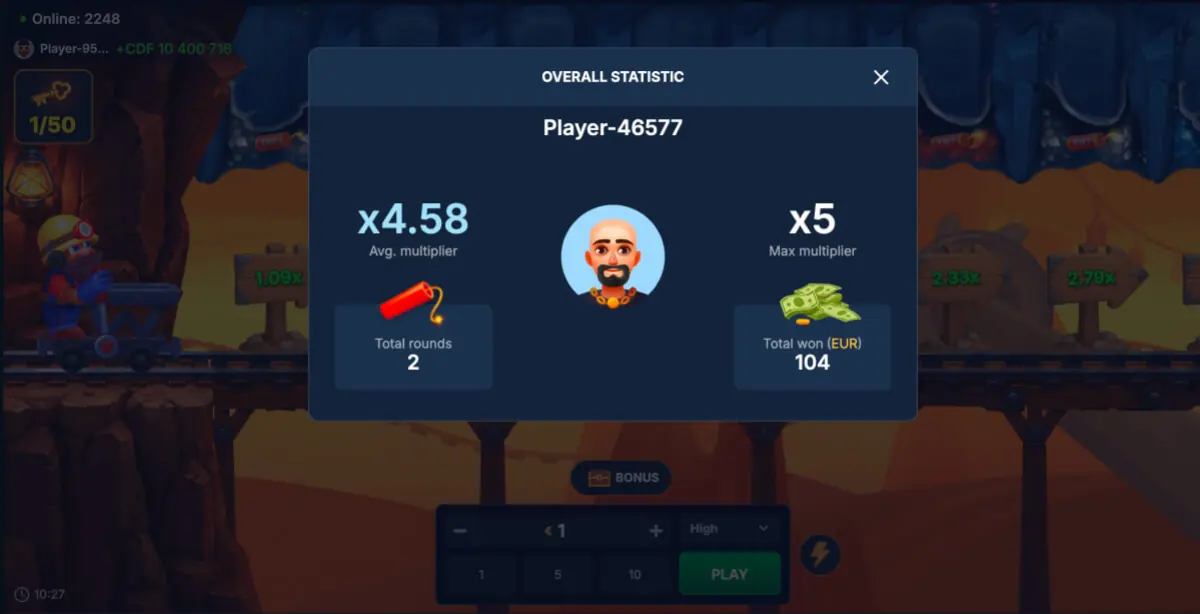
The result overlay separates round multiplier, total multiplier and keys. Check the settlement there instead of inferring it from animation size, sound or the miner's reaction. Visual celebration does not redefine the recorded amount.

Round sequence

How one Mine Rush round moves

The sequence repeats. The useful skill is not predicting TNT; it is knowing which state the round occupies and which value is still at risk.

01

Set a session boundary

Decide the total budget and session length before opening a real-money game. A stake is affordable only inside that boundary. Money needed for bills, debt payments or savings is not a gambling budget.

02

Select stake and difficulty

Choose both fields deliberately. If collecting keys is part of the session, remember that progress is segmented. Switching from €1 Low to €1 Medium moves to another track rather than accelerating the first one.

03

Press GO once

The cart advances to the next decision state. Avoid double taps on a slow connection. Wait for the interface to confirm the result and check the account history if the screen freezes.

04

Identify safe step or TNT

A safe step raises the current cash-out value. TNT ends the open round. The animation reveals the result; it does not create a timing window in which a faster tap changes an already registered outcome.

05

Settle or take another step

CASH OUT banks the displayed return. GO exposes the current stake and accumulated open return to another uncertain result. Decide from the preset rule, not from a feeling that the cart is “hot.”

06

Review the record

After settlement, compare the balance and round history. If a key appeared, confirm the correct counter. Screenshots are useful for a support case, but remove names, account IDs and payment data before sharing them.

Mine Rush route with GO and CASH OUT controls
The main decision screen keeps both actions under the route. Only the displayed current return is available to settle.

State table

What each outcome changes

EventOpen wagerMultiplierKeysNext action
Safe checkpointStill exposedIncreasesMay add up to oneGO or CASH OUT
Cash outSettledLocks at displayed valueCredited keys remainStart a new round
TNTLost if uncashedOpen return endsCredited keys remainStop or start again
50th keyNormal round resolvesDepends on roundThreshold reachedRegular bonus opens
Setting changeNo active round recommendedNew route profileShows matching trackConfirm before GO

A key is not a refund. Preserving progression can make a losing round feel less empty, but the lost stake remains lost. The bonus reached later also carries variable outcomes, so its existence does not cancel the 4% theoretical house edge.

Mine Rush result statistics with multiplier and key fields
Use the statistics overlay to separate the round result from long-term key progress.

Risk modes

Low, Medium and High are pace choices

Risk mode changes how quickly the route can become volatile. It does not turn Mine Rush into a skill game and does not make past results informative.

ModePractical readingSuitable practice goalUnknown field
LowSlower risk/reward progressionLearn the interface and settlement flowExact per-step probability
MediumMiddle route profileCompare decision pressure with LowExact multiplier distribution
HighSharper risk/reward progressionObserve variance with virtual creditSeparate published RTP

Do not infer the probability table by counting a small personal sample. A run of twenty or fifty rounds is far too small to describe a long-run model, and interface outcomes can be grouped in ways a player cannot see. The honest conclusion is limited: the provider publishes three modes, while their exact numerical curves are absent from the public product page.

If the operator supplies a rules panel with mode-specific RTP or probabilities, use that current panel for the session. Record the operator, date and game version when comparing it with another implementation. Do not carry a number from Chicken Road, Mines or a generic crash calculator into Mine Rush.

Progress outside the wager

How keys and Treasure Hook connect

The key system is Mine Rush's clearest difference from a standard crash round. It is also the easiest field to misunderstand when stake or difficulty changes.

Keys survive TNT

Once the interface credits a key, TNT does not remove it. This persistence applies between sessions as described by VeliPlay. It does not mean every GO step awards a key.

Progress is segmented

Each stake-and-difficulty pair has its own total. A player who frequently changes both can spread progress across many tracks and take longer to see one counter reach 50.

Fifty opens the bonus

The regular Treasure Hook Bonus starts automatically at the threshold. Direct access is also shown at 50× for Standard and 100× for Premium; those purchases are separate from earned key entry.

Mine Rush Treasure Hook chest bonus with three lives
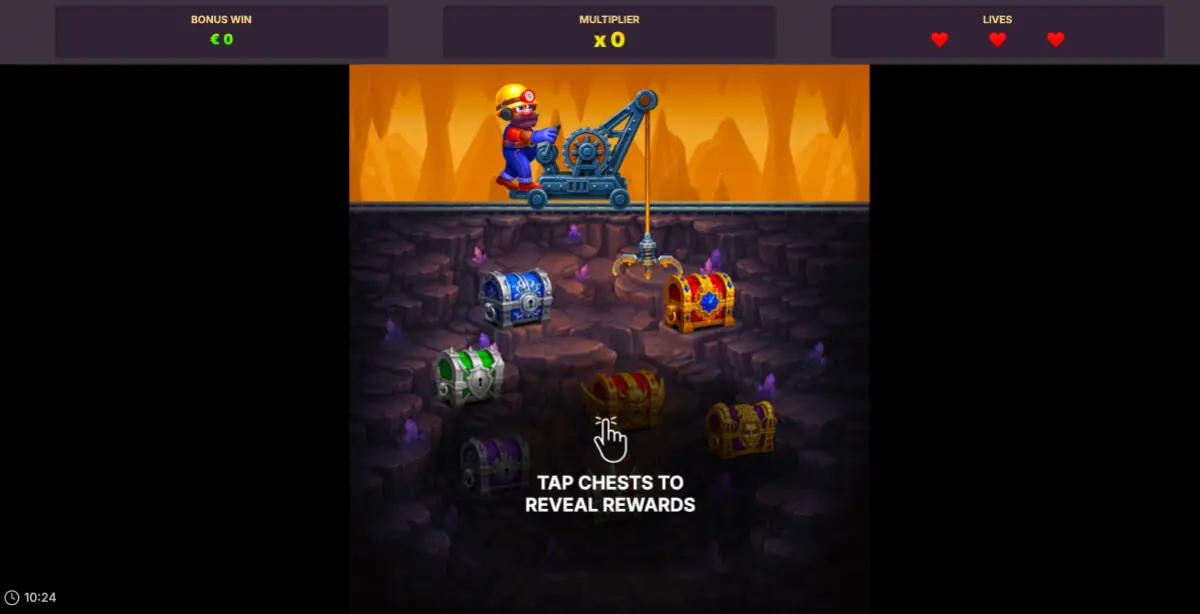
Treasure Hook begins with three lives. Chest results can add cash, multipliers or another life.

During the chest stage, each selection changes the running bonus state. The visual pool differs between the regular and Premium presentation, but public screenshots do not reveal the probability attached to each reward. A larger-looking chest or brighter colour should not be treated as a disclosed odds table.

Error prevention

Seven mistakes that change the experience

  1. Pressing GO before confirming the stake

    The previous stake may remain selected. Pause at the setup state and read the field aloud if necessary.

  2. Confusing an open multiplier with settled money

    The number becomes a return only after CASH OUT succeeds and the balance or history records it.

  3. Chasing a key counter with larger stakes

    A bonus target does not make the next wager cheaper. Raising the stake increases money exposed and can move progress to another track.

  4. Reading TNT streaks as a pattern

    Recent outcomes do not establish that safety or TNT is due. Stop rules should depend on budget and time, not streak interpretation.

  5. Assuming demo balance equals real conditions

    Virtual credit teaches layout. It does not test withdrawals, KYC, network delays, operator limits or emotional response to loss.

  6. Downloading an unrelated APK

    VeliPlay does not link a standalone Mine Rush APK on the public page. Similar names in app stores may belong to unrelated games.

  7. Continuing after the interface desynchronises

    Stop input, capture the round ID and check history. Repeated taps can create more confusion while the account state catches up.

Plain-language reference

Mine Rush glossary

RTP
The provider-published long-run return percentage. Mine Rush lists 96%; it is not a personal refund rate.
House edge
The mathematical gap between 100% and RTP. Here it is 4%, calculated rather than independently audited by this site.
Multiplier
A factor applied to the stake when a return is settled. A 2× return on €1 equals €2 total, including the original stake.
Variance
How widely short sequences can move around the long-run average. Difficulty changes risk presentation, while exact curves remain unpublished.
Cash out
The action that ends the round and records the current displayed return before another uncertain step.
TNT
The losing route outcome that closes an uncashed round. Previously credited keys remain.
Key track
A persistent counter attached to a particular stake and difficulty combination.
Bonus Buy
Paid direct entry to the chest feature at a multiple of the current stake. It is not a deposit bonus or a profit promise.
Before real play: check the current in-game rules, operator licence, age requirement, deposit limits, session controls and dispute route. If any field conflicts with this guide, pause and send the dated rule screen to our corrections desk.

Detailed field notes

Read the edge cases before a funded round

Connection loss after GO

A game animation and the server record are not the same layer. If the browser disconnects after GO, do not assume that closing the tab cancels the wager. Reconnect through the verified operator, open game history and compare the round ID and balance. If no record appears, stop play and open a ticket with the UTC time, stake and selected mode. Repeated taps can add new requests while the interface is recovering.

Connection loss during a cash-out request

Settlement should be judged from the server-side result and account history, not from whether the button animation completed. Save a screenshot of the displayed multiplier, but understand that a screenshot alone cannot prove the exact server receipt time. Ask the operator for the round log. Do not place a replacement wager while the disputed amount is unresolved.

Changing currency or account

Key progress may depend on the authenticated account and the stake values supported in that currency. A counter shown under one account should not be assumed to follow another login, demo session or casino. The public provider page says progress persists between sessions for each bet and difficulty combination; it does not promise transfer between operators or currencies.

Reading a multiplier correctly

A return multiplier normally includes the stake. If €1 settles at 2×, the total return is €2 and the profit is €1. An interface may separately label total win, round multiplier and cumulative values. Use the paytable wording in the current build. Never add the original stake twice merely because the result panel and balance update appear at different moments.

Using accessibility settings

Keyboard focus should reach navigation, forms and FAQ controls. Browser zoom can enlarge text without hiding the current action. Reduced-motion preference pauses nonessential page effects; inside a third-party game, use its own sound and animation controls. A player who cannot reliably distinguish GO from CASH OUT should not continue until the operator provides an accessible interface.

Sound and visual cues

Audio, sparks and cart speed are feedback, not probability information. Muting the game does not alter RTP, and an unusually dramatic animation does not identify a better chest. Read numerical fields and confirmed result history. This also reduces the risk of confusing entertainment effects with a signal to continue.

End-of-session record

Write starting balance, total deposits, withdrawals, total stake if available, ending balance, duration and whether limits held. Do not use the record to predict TNT. Its purpose is to reveal spending and behaviour. If the session exceeded the written boundary, strengthen controls before any return and consider cooling-off or self-exclusion.

Round reconciliation

Check the result without replaying the decision

Build a simple event record

For a disputed round, note the operator, UTC time, round identifier, starting balance, selected stake, difficulty, visible multiplier, action taken and ending balance. Keep the screenshot uncropped so the surrounding interface can establish context. A result panel without an identifier may help explain the issue but is weaker than account history tied to the server record.

Separate display delay from settlement

A balance can update before or after an animation finishes. The authoritative question is which action reached the server under the current rules, not which frame remained on screen. Pause further input, reload through the verified operator and compare history. If the same round appears twice or not at all, report it rather than trying to correct the balance through another wager.

Practice the non-game controls

Before real-money use, locate help, history, sound, fullscreen exit, stake reduction and the operator's responsible-gambling controls. Test keyboard focus and browser back behaviour. Know whether closing the game returns to the lobby or leaves an active overlay. These details do not change RTP, but they reduce errors when a session becomes stressful.

End the walkthrough by explaining the mechanic aloud: GO exposes the stake to the next step; CASH OUT settles the currently offered value; TNT ends the round; keys may persist on the exact stake-and-mode track; fifty credited keys open the regular feature. If any part cannot be stated confidently, return to demo and the current in-game rules.

A careful first session should repeat this verbal check after any layout or rule update. Screens, labels and operator wrappers can change even when the title name stays the same.

Direct answers

Frequently asked questions

Select a stake and Low, Medium or High risk, then press GO. After a safe checkpoint, choose CASH OUT to settle or GO to accept another uncertain step.

TNT ends the open round and the uncashed stake is lost. Keys already credited remain stored for the matching stake and difficulty track.

VeliPlay names Low, Medium and High modes but does not publish a separate RTP or step-probability table for each mode on the public page. Check the active in-game rules.

There is no universally correct checkpoint. Choose a limit before the round, understand that another step can lose the open return, and do not treat recent TNT locations as a signal.

The interface stores key progress separately for each bet and difficulty combination. Changing either field can reveal a different counter; it does not necessarily erase the earlier total.

The regular Treasure Hook Bonus opens automatically. The bonus begins with three lives and chests can add cash, a multiplier, an extra life or a combination.

A demo, when offered by an authorised operator, can teach the controls and screen flow with virtual credit. It cannot predict live outcomes or prove withdrawal quality.

Content update history

Content update history
  • — facts, internal links, structured data and mobile layout checked.
  • — initial evidence map and page outline prepared.
Mine Rush
18+ · Terms apply
Play now