
You control
- Whether to play at all
- Session budget and duration
- Stake and displayed risk mode
- Whether to cash out after a safe step
- Whether to buy a bonus
- When to take a break or self-exclude
Mine Rush field guide
A useful Mine Rush strategy controls exposure; it does not claim to predict TNT. The published 96% RTP leaves a calculated 4% house edge, while exact step probabilities remain undisclosed. That makes budget, turnover and stop rules more defensible than pattern systems.
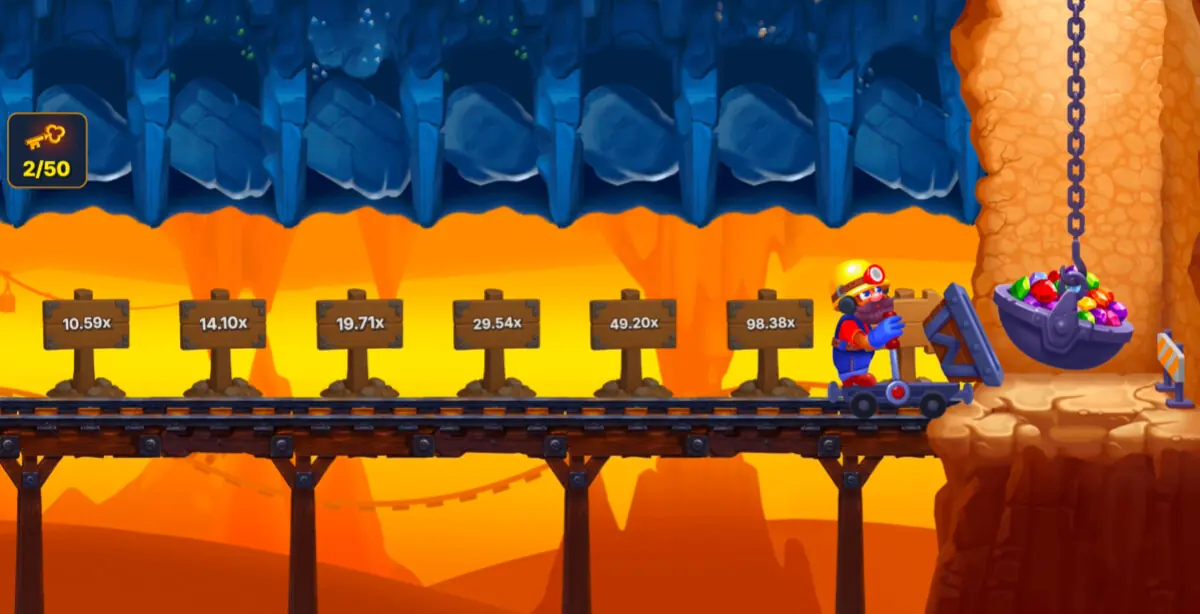
The math
Mine Rush publishes 96% RTP. Subtracting 96 from 100 produces a 4% theoretical house edge. If total wagering reaches €100, the long-run model retains €4 on average and returns €96 across the player population. A short session can finish with a total loss, a profit or anything between; the calculation does not schedule results.
Turnover is the sum of every stake, including money wagered again after a return. A €20 deposit can generate €100 of turnover if the balance is recycled through many rounds. This is why session pace matters. The cost model follows turnover rather than the starting deposit.
| Stake | Rounds | Turnover | 4% expected loss |
|---|---|---|---|
| €0.20 | 50 | €10 | €0.40 |
| €0.50 | 100 | €50 | €2 |
| €1 | 100 | €100 | €4 |
| €2 | 150 | €300 | €12 |
These figures use the provider-published RTP and simple arithmetic. They do not estimate the chance of reaching a specific sign, collecting a key or opening a given chest. Those probabilities are not public in the evidence set.
Decision framework
A strategy claim is credible only if it changes a field the player actually controls and states the trade-off. Reducing stake size can extend the number of decisions available within a budget. It does not change the return percentage. Cashing out earlier may create more frequent small settlements, but it also gives up later multipliers and has no published proof of a higher expected return.
Three plans
Use virtual credit where available. Keep one stake and Low mode fixed, then identify GO, CASH OUT, result history and the key counter. The goal is accurate screen reading, not a target balance.
Stop after the control flow is clear. Demo repetition beyond that can create false confidence because no real withdrawal, KYC or loss emotion is involved.
Choose a maximum turnover rather than only a deposit. A €25 cap at €0.25 per decision allows at most 100 initial stakes. Returns reused for later rounds still count toward the cap.
Record rounds or use a timer. Stop when either the turnover ceiling or time boundary arrives, even if key progress sits near 50.
Choose a checkpoint rule before GO. This reduces in-round hesitation and helps prevent multiplier chasing. It changes the shape of results rather than the underlying published edge.
Do not raise the target after a loss or lower it only because a recent TNT felt close. Changing rules mid-session often hides loss chasing.
Difficulty
The labels provide a relative choice but not a public numerical table. Low is appropriate for learning the UI because the progression is presented as less aggressive. Medium can demonstrate the increased pressure of later decisions. High should be explored with virtual credit before any real stake because rapid multiplier growth can encourage continuation.
There is no basis for rotating modes after a TNT, and no evidence that a mode becomes “due.” Because key progress is separated by stake and difficulty, rotation can also scatter counters and make the 50-key route harder to follow. If progression matters, keep the pair consistent within the planned budget rather than increasing exposure to chase the counter.
| Question | Evidence-based answer | Action |
|---|---|---|
| Which mode has the highest RTP? | Not published by mode | Check current game rules; do not guess |
| Which mode wins most often? | Exact frequencies not public | Use labels only as relative guidance |
| Does switching reset progress? | Separate tracks are displayed | Return to the original pair to verify |
| Can High recover losses faster? | No recovery guarantee | Never increase risk to chase a balance |
Worked bankrolls
A 1% stake would be €0.20 if that option exists at the chosen operator. Fifty initial decisions produce €10 turnover and a €0.40 theoretical expected loss. The actual result will vary. Set a 20-minute timer and do not redeposit when the boundary is reached.
A 1% stake is €0.50. One hundred decisions create €50 turnover and €2 theoretical expected loss. If returned funds are wagered again, total turnover can exceed €50 even though the deposit did not. Track cumulative stakes, not only the balance.
At a €1 stake, Standard costs €50 and Premium costs €100. The Premium entry is twice the price before any chest opens. A €50 session budget cannot absorb a €100 purchase. Buying it with a higher balance still concentrates many ordinary stakes into one variable feature result.
A loss stop might end the session at €15 below the starting balance. A win stop might end it at €20 above. Neither changes RTP; both make the stopping decision before emotion rises. A time stop remains necessary because repeated small settlements can create large turnover without a dramatic balance change.
Myths
The provider media shows animations, not a predictive map. Similar cart positions do not prove shared future outcomes.
Time away can improve self-control, which is useful. It does not alter the next outcome's hidden probability.
Switching changes the selected track. No source shows that it resets RNG state or creates a favourable round.
Keys preserve progression only. They do not restore a TNT stake or guarantee that the later chest result covers earlier losses.
Premium has upgraded presentation and costs 100×. The public page does not disclose a separate RTP or reward probability table.
No third-party predictor can be verified from provider evidence. Files making that claim create phishing, malware and account-theft risk.
Calculator
Session checklist
Use only a lawful operator available in your location. Do not use technical workarounds to evade restrictions.
Write all three limits. A balance alone does not reveal how much has been recycled through wagers.
A stable setup makes key progress and session records easier to read.
Use the same rule through the planned test rather than changing it after emotional outcomes.
Budget, loss, win, time or signs of distress can end the session. A nearly completed key track is not an exception.
Use history to reconcile settlements and behaviour, not to forecast the next TNT.
Strategy audit
A strategy claim should name the input it changes, the measurable outcome, the sample needed and the evidence source. “Cash out earlier” changes settlement size and likely frequency. “TNT appears after three safe rounds” claims predictive power and needs provider or independently reproducible evidence. No such evidence appears in the Mine Rush source set.
Separate expected value from variance. Two plans can share the same long-run return while producing different-looking sessions. Frequent small settlements may feel calmer, but one losing continuation can erase several of them. Rare larger targets can produce long sequences without settlement. Preference for one pattern is not proof that its expected value is higher.
Do not optimise for key speed without including wagering cost. If a player raises the stake to keep a preferred counter active, every GO exposes more money. If the player changes difficulty to seek keys, progress moves to another track. The key is a feature event, not a rebate denominator in the published RTP.
A useful test uses virtual credit, a fixed mode and a written observation question such as “Can I identify the settlement state?” It should not use a profit target as validation. Demo balances are arbitrary, and a winning virtual run does not establish the distribution of the next funded sequence.
Session data should be used for self-audit. Calculate turnover, average stake, duration and limit breaches. A result history cannot reveal a due event when outcomes are independent or when the model is undisclosed. If reviewing history increases the urge to chase, stop collecting game data and use account-level exclusion tools.
Bonus purchase decisions need a separate budget because 50× and 100× concentrate many stakes into one action. Never fund Premium from money reserved for ordinary rounds. Without a public feature probability table, the only exact comparison is price: Premium costs twice Standard at the same stake.
Decision review
A session review can measure total stake, number of decisions, time, largest stake, feature purchases and whether a preset stop was respected. It cannot establish that a TNT event is due or that a mode has become warm. Use the data to change access and limits, not to manufacture a forecast from a small sample.
Write in advance what happens if the plan is broken. The safest response is to stop, not to create a more aggressive recovery system. Repeated limit breaches indicate that account tools, a cooling-off period or self-exclusion are more appropriate than spreadsheet refinement. A strategy page should never turn loss chasing into an optimisation exercise.
Compare plans at equal turnover when discussing theoretical cost. Ten €1 decisions and one €10 decision both create €10 turnover, although their visible variance and interaction differ. Feature purchases also belong in turnover. Omitting them makes the session appear cheaper than it was and can hide the effect of concentrated exposure.
Keep the original record after a loss; rewriting the target afterward removes its value as a behavioural check.
Direct answers
No published betting or cash-out pattern removes the house edge. A plan can limit stake size, session length and variance exposure, but it cannot create positive expected value.
Low describes the relative route setting, not a loss-free mode. It may change the pace of multipliers and TNT exposure, while every real-money wager can still be lost.
The game stores separate progress for each stake and difficulty pair. Switching modes shows another track; return to the original pair to see its saved total.
Total theoretical expected loss equals turnover multiplied by 4%. One hundred €1 rounds create €100 turnover and a €4 long-run expected loss, not a predicted session result.
No public evidence supports streak prediction. A cluster of TNT or safe steps does not make the opposite result due.
It is a high-cost entry option, not a method for improving RTP. Compare its cost with the session budget and do not assume upgraded visuals disclose better value.